Choosing the wrong molding process for plastic bottles often results in misaligned tooling budgets, unacceptable scrap rates, or compromised seal integrity. Manufacturers constantly face immense pressure to deliver flawless packaging without inflating capital expenditures. Selecting a production method based strictly on preliminary estimates ignores vital variables. Bottle geometry, required neck precision, and expected production volume dictate long-term project viability. When you apply the wrong technique, you risk operational bottlenecks and compliance failures down the line. This article provides an objective, engineering-focused comparison to help procurement and product teams finalize their manufacturing strategy. You will discover exactly how these technologies differ in everyday production scenarios. By examining their distinct advantages and inherent limitations, we give you the actionable data needed to launch your next packaging project confidently.
Key Takeaways
- Injection Blow Molding (IBM) offers superior neck precision and zero scrap, making it the standard for small medical, pharmaceutical, and cosmetic bottles.
- Extrusion Blow Molding (EBM) provides unmatched versatility for complex geometries (like molded handles) and large-capacity containers at a lower initial tooling cost.
- The primary decision driver is usually a trade-off between strict dimensional tolerances (favoring IBM) and unit size/shape flexibility (favoring EBM).
- Tooling amortization depends heavily on volume; IBM requires higher upfront capital but can yield lower unit costs at massive scale due to zero flash.
Understanding the Mechanical Differences
The core distinction between these two dominant manufacturing methods lies in how the plastic is initially formed before blowing. Both processes ultimately rely on air pressure to shape the bottle against a cold cavity wall. However, their starting states fundamentally dictate the physical capabilities of the final product. Understanding this physical origin helps engineering teams anticipate part behavior during mass production.
The IBM Process
In this method, plastic is first injection-molded into a solid preform around a steel core pin. The machine injects molten polymer under high pressure into a precise cavity. This creates a fully formed, threaded neck finish before any blowing occurs. Next, the machine transfers the core pin carrying the hot preform into a secondary blow mold. Compressed air enters through the core pin, expanding the preform outward against the cavity walls. Finally, the finished bottle moves to an ejection station.
The EBM Process
Conversely, the EBM process completely bypasses the injection phase. The equipment extrudes molten plastic continuously as a hollow tube, known as a parison. The mold halves close directly around this descending tube. As the mold shuts, it pinches the top and bottom of the parison. A blow pin inserts into the neck area, inflating the trapped plastic to match the mold cavity. This approach forms the entire bottle simultaneously.
Assumption Check
Engineers often assume injection vs extrusion blow molding are interchangeable for basic shapes. This is a dangerous misconception. The preform guarantees uniform material distribution and absolute dimensional control at the neck. The extruded parison, while highly versatile, relies on mechanical pinching to seal the base and neck. This pinch-off inherently creates scrap and structural variances. Your starting state determines your end-use reliability.
Extrusion Blow Molding: Capabilities and Constraints
This technique champions versatility and scale. Manufacturers rely on it to produce high-volume consumer goods rapidly. The mechanics allow for rapid adaptations on the factory floor, making it an agile choice for broad consumer packaging.
Ideal Use Cases
You will find this method behind most large-format containers. Think of gallon milk jugs, 55-gallon industrial drums, and bulky automotive fluid reservoirs. It also dominates the household chemical market. Shampoos, detergents, and motor oils rely heavily on this process. Crucially, any design requiring an integrated, hollow handle must use this method.
Equipment Dynamics
A modern extrusion blow molding machine is highly adaptable. It supports a vast array of thermoplastic materials. You can easily process High-Density Polyethylene (HDPE), Polypropylene (PP), and even flexible PVC. Furthermore, these machines easily support multi-layer co-extrusion. This capability allows you to sandwich barrier layers inside the bottle wall, extending the shelf life of food and agricultural chemicals.
Business Advantages
Choosing this route offers several compelling financial and operational benefits:
- Lower initial tooling costs: Producing a single set of blow molds costs significantly less than buying the complex dual-mold systems required for other methods.
- Faster mold-making lead times: Simpler mold designs mean toolmakers can deliver production-ready molds weeks earlier.
- Part weight flexibility: Operators can program the parison thickness on the fly. You can adjust the bottle weight dynamically without altering the physical steel tooling.
Limitations & Risks
Despite its flexibility, this method presents distinct engineering challenges. The process inherently generates "flash" at the pinch-off points located at the neck and base. Facilities must trim this scrap material mechanically. This necessitates robust secondary recycling processes to regrind and blend the waste back into the virgin material stream.
Additionally, the neck finish forms by blowing against a cavity, rather than injecting under high pressure. This results in lower precision on the threads. If your product requires a strict liquid-tight or gas-tight seal, this variance can compromise closure integrity.
Injection Blow Molding: Capabilities and Constraints
When packaging demands absolute perfection, this method takes over. It sacrifices large-scale versatility for surgical precision. Procurement teams favor this route when regulatory compliance outweighs initial tooling expenditures.
Ideal Use Cases
This process dominates the medical and personal care sectors. It produces pharmaceutical pill bottles, precise eye dropper containers, and high-end cosmetic packaging. Generally, this method is economically restricted to small-capacity containers, typically under one liter.
Equipment Dynamics
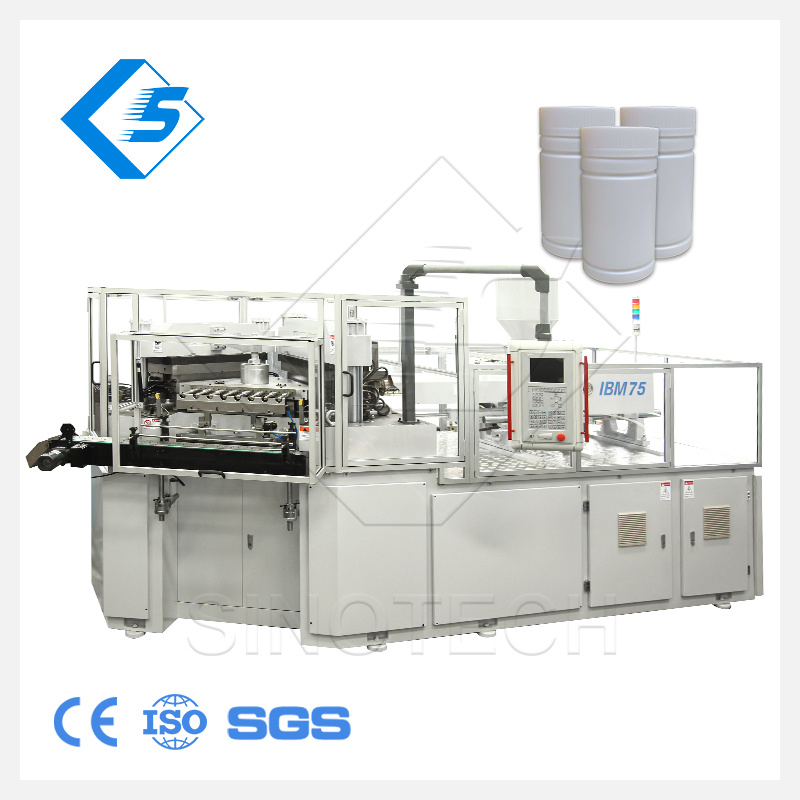
An advanced injection blow molding machine operates on a highly precise multi-station indexing system. The standard layout includes three stations: inject, blow, and eject. The tooling is complex and heavily engineered. It requires an injection cavity, a blow cavity, and precisely machined core pins. The machinery demands exact temperature control and clamping force calculations.
Business Advantages
The operational benefits heavily favor long-term quality and consistency:
- Flashless production: The process generates zero scrap. You eliminate secondary trimming stations and the risk of regrind contamination completely.
- Exceptional dimensional accuracy: Because the neck finish forms inside an injection mold under high pressure, the threads are flawless. This ensures compliance with strict regulatory sealing standards for child-resistant closures.
- Superior visual finish: The preform step ensures highly consistent wall thickness. This translates to exceptional visual clarity, eliminating the weld lines often seen in extruded bases.
Limitations & Risks
This precision comes with significant barriers to entry. The upfront tooling investments are steep. You must pay for both an injection mold and a blow mold for every bottle design. Furthermore, the physics of the core pin make it entirely incapable of producing bottles with hollow handles. Finally, the high tooling cost makes this method economically unviable for low-volume production runs.
Evaluating Injection vs Extrusion Blow Molding for Your Project
Selecting the right path requires mapping your product specifications against manufacturing realities. Do not base your decision on a single variable. A holistic evaluation prevents costly tooling reworks and production delays.
Cost vs. Volume Matrix
Tooling amortization is the crucial metric here. The preform-based process requires massive production volumes to absorb its high tooling costs. However, once you hit millions of units, the elimination of scrap and trimming labor drives the unit cost down. Conversely, the continuous extrusion method is far friendlier to mid-volume runs. The cheaper molds offset the slightly higher scrap handling costs on smaller campaigns.
Comparison Matrix: IBM vs EBM Evaluation Criteria
| Evaluation Criteria | Injection Blow Molding (IBM) | Extrusion Blow Molding (EBM) |
| Tooling Investment | High (Injection + Blow molds) | Low to Moderate |
| Neck Precision | Exceptional (Injection formed) | Moderate (Blown formed) |
| Scrap Generation | Zero (Flashless) | High (Requires trimming) |
| Bottle Size Range | Micro to 1 Liter | Ounces to 55+ Gallons |
| Handle Capability | Not Possible | Easily Integrated |
Design & Geometry Limitations
Geometry often dictates the choice before cost is even considered. If your bottle design requires a hollow handle, you must choose extrusion. The core pin used in the alternative method cannot navigate around a handle cavity. Similarly, if your bottle exceeds two liters in capacity, extrusion is highly recommended. Expanding a preform into a massive container causes severe material thinning and structural weakness.
Tolerance and Compliance
Closure integrity is non-negotiable for medical and pharmaceutical applications. A leaking chemical or compromised drug dosage carries catastrophic liability. The injection phase guarantees precise thread profiles and smooth sealing surfaces. If your cap requires an induction seal or a specialized child-resistant mechanism, the preform method provides the exact dimensional control needed to pass regulatory compliance testing consistently.
Material Suitability
Resin handling behaves differently in both systems. When extruding a parison, you must account for "melt strength." Gravity pulls down on the hot plastic tube before the mold closes. Materials like heavy HDPE resist sagging well. Materials with low melt strength, like certain grades of PET, sag rapidly and complicate the parison process. Meanwhile, the injection phase easily handles low-melt-strength resins because the steel mold fully supports the hot preform.
Implementation Risks and Production Realities
Theoretical capabilities often crash into factory floor realities. Procurement teams must anticipate the hidden logistical challenges tied to each molding method. Proper planning ensures seamless scale-up and prevents surprise budget overruns.
Tooling Lead Times
You must factor mold-making timelines into your product launch schedule. Precision injection molds require intricate cooling channels, hot runner systems, and micro-tolerances. Designing, machining, and validating these tools can take 12 to 16 weeks or longer. In contrast, standard extrusion blow molds are simpler aluminum or steel blocks. Toolmakers can often turn them around in half the time, giving you a faster time-to-market.
Scrap Management (EBM)
The hidden cost of continuous extrusion is waste management. Trimming the tails and necks generates constant scrap. Facilities must manage grinders, conveyer systems, and blending stations to route this flash back into the hopper. You must meticulously monitor the regrind ratio. Introducing too much recycled plastic degrades the material properties, compromising drop-impact strength and environmental stress crack resistance.
Implementation Flow Chart: Risk Mitigation Strategies
| Production Stage | IBM Risk Management | EBM Risk Management |
| Tooling Design | Verify core-shift calculations early. | Optimize pinch-off geometry for clean trims. |
| Material Prep | Strict moisture control for PET resins. | Monitor virgin-to-regrind blending ratios. |
| Quality Control | Front-loaded dimensional checks. | Continuous downstream flash inspections. |
Quality Control Checkpoints
- Upstream Validation: Precision preform methods front-load the quality control. Once you qualify the tooling, the process remains incredibly stable. Machine operators merely monitor temperatures and pressures.
- Downstream Inspection: The extrusion method demands robust downstream inspection. Because of the mechanical trimming, operators must constantly check for rough neck finishes, incomplete pinch-offs, and bottom seal leaks.
- Weight Distribution Checks: Both processes require routine wall thickness testing to ensure material distributes evenly during the blow phase.
Conclusion
Selecting the optimal molding process requires a balanced assessment of design requirements and production economics. Default to the extrusion method for large, complex, or handle-bearing containers. Its flexibility and lower tooling costs make it ideal for household chemicals and bulk packaging. Conversely, default to the preform-based injection method for small, high-precision bottles. When seal integrity and zero-scrap aesthetics are paramount, the higher initial investment easily justifies the flawless output.
- Finalize your bottle design to confirm if handles or extreme capacities eliminate the preform method early.
- Define your strict neck tolerances; if child-resistant caps are mandatory, prioritize injection-formed threads.
- Map out your projected annual volume to calculate precise tooling amortization timelines.
- Determine your maximum tooling budget before issuing RFQs to potential contract manufacturers.
FAQ
Q: Can extrusion blow molding produce flashless bottles?
A: No. EBM inherently creates flash at the pinch-off points (top and bottom) as the mold closes over the continuous plastic parison. This excess material must be mechanically trimmed off downstream and is usually ground up and recycled back into the production line.
Q: Which process is more cost-effective for a production run of 50,000 units?
A: Generally, EBM is more cost-effective for smaller runs. The significantly lower tooling cost offsets the slightly higher unit and scrap handling costs. IBM requires complex, dual-mold tooling setups that rarely achieve ROI on a short run of 50,000 units.
Q: Why is injection blow molding preferred for pharmaceutical bottles?
A: Because the neck is injection-molded under high pressure, it offers exact dimensional control. This flawless precision is mandatory for securely fitting child-resistant (CR) caps and induction seals, which drastically reduces the risk of dangerous chemical leakage or external contamination.

