For plastic container manufacturers and packaging engineers, selecting the right blow molding process is a critical capital expenditure decision. It dictates production agility, unit economics, and final product quality. Evaluating whether to invest in an integrated single-stage system versus a decoupled two-stage system requires careful balance. You must weigh visual clarity requirements, footprint constraints, and target production volumes. If you choose incorrectly, you risk degraded bottle aesthetics or wasted factory floor space. This guide breaks down the technical realities of one step injection stretch blow molding. We provide a transparent evaluation framework for production facility managers. You will learn how the machine architecture functions and where this process outperforms alternatives. We also reveal how to decide if this integrated process aligns strictly with your operational goals.
Key Takeaways
- The one-step process integrates preform injection and stretch blowing into a single machine, eliminating preform cooling, storage, and reheating.
- It is the industry standard for producing highly customized, blemish-free containers (cosmetics, pharma, custom food packaging) where visual quality outranks pure production speed.
- While capital costs for one-step molds are generally higher and cycle times slower than two-step systems, it offers superior control over neck orientation, threading precision, and non-round shapes.
- Evaluating a one-step ISBM machine requires analyzing Total Cost of Ownership (TCO), including footprint savings, energy efficiency, and tooling changeover times.
The Mechanics of One-Step Injection Stretch Blow Molding
To understand the single-stage advantage, you must first map the physical flow within the equipment. The architecture typically relies on a rotating carousel. This setup moves the plastic through distinct phases without ever leaving the machine. It establishes a highly controlled technical baseline.
The 3-to-4 Station Architecture
Most modern single-stage systems operate on a three-station or four-station indexing sequence. We can break down this continuous loop into the following steps:
- Station 1: Injection. Plastic resin pellets melt inside the extruder barrel. The machine injects this molten resin into a preform mold. Here, the machine precisely forms the neck finish. Resins often include PET, PP, PC, or Tritan.
- Station 2: Conditioning (Optional). Many advanced machines utilize a dedicated thermal conditioning station. The preform temperature equalizes to the optimal blowing temperature. It never drops to room temperature. This prevents unwanted crystallization.
- Station 3: Stretch Blow. A mechanical stretch rod extends the preform longitudinally. Simultaneously, high-pressure air expands it laterally. The plastic presses tightly against the blow mold cavity walls to form the final shape.
- Station 4: Ejection. Grippers remove the finished containers from the tooling. The bottles are fully formed, cooled, and ready for immediate packaging or filling lines.
Thermal Efficiency Advantage
This integrated architecture provides massive energy benefits. It retains the latent heat generated during the initial injection phase. Two-step systems require massive infrared reheating ovens to soften cold preforms. Single-stage machines eliminate these ovens entirely. This direct heat retention radically lowers electrical consumption metrics. It also prevents heat-degradation issues commonly found when reheating thick-walled preforms.
Common Mistake: Facility managers often underestimate cooling water requirements for single-stage systems. While you save on reheating energy, the injection station demands robust chiller capacity to solidify the neck finish quickly.
One-Step vs. Two-Step ISBM: A Production Decision Framework
Choosing between one-step and two-step architectures is rarely straightforward. Each system serves distinct market segments. You must evaluate these systems across four primary production criteria.
Visual Quality & Surface Finish
Single-stage systems grip the preform by the neck ring throughout the entire cycle. The preforms never touch each other. In contrast, two-step systems eject preforms into large storage bins. They collide, rub, and scratch against one another. One-step systems prevent this surface damage entirely. This makes the single-stage approach mandatory for scratch-free, luxury-grade packaging. Cosmetics and premium spirits demand this flawless visual clarity.
Production Volume & Cycle Times
We must acknowledge the production speed trade-off. Two-step machinery remains superior for massive, continuous runs. Think of commodity water or soda bottles. They churn out millions of identical units rapidly. Single-stage systems run slower cycle times. The process is optimized for low-to-medium volumes. This typically ranges from one million to twenty million units annually. It excels in environments requiring frequent mold changeovers.
Dimensional Accuracy
Integrated manufacturing provides incredibly tight dimensional tolerances. Because the preform never leaves the transfer mechanism, neck alignment remains perfect. The thread positioning does not shift. This precision is crucial for specialized dispensing pumps. It is equally important for directional closures, like trigger sprayers, where the cap must align perfectly alongside the bottle face.
Supply Chain Footprint
Standalone blow molders require massive physical floor space. You must store and quarantine raw preforms in large Gaylord boxes before blowing them. Single-stage equipment eliminates this intermediate inventory. You feed raw resin pellets into the hopper, and finished bottles exit the conveyor. This drastically reduces warehouse footprint and simplifies supply chain logistics.
Process Comparison Summary
Production Process Comparison: One-Step vs. Two-Step
| Production Criteria | One-Step ISBM | Two-Step ISBM |
| Visual Clarity | Pristine (No preform scratches) | Prone to scuffing during storage |
| Ideal Annual Volume | 1 Million to 20 Million units | 50 Million+ units |
| Footprint | Compact (No preform storage needed) | Large (Requires warehousing bins) |
| Neck Alignment | Highly precise (Directional closures) | Variable (Depends on infeed tracking) |
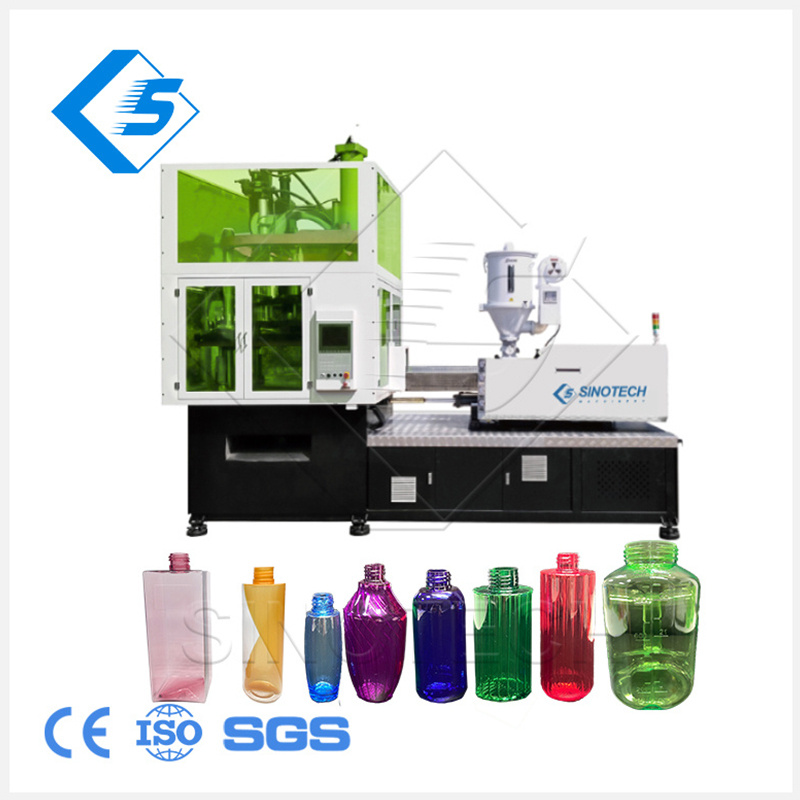
Core Applications: Where the One-Step Process Outperforms
Certain industries cannot compromise on container aesthetics or structural integrity. For these sectors, integrated stretch blow molding is the only viable manufacturing method.
Cosmetics & Personal Care
The beauty industry relies heavily on visual differentiation. Brands demand heavy-wall PET jars that mimic glass. They need mascara tubes and asymmetrical lotion bottles. These designs require pristine clarity. They also demand exact directional neck alignment. If the lotion pump faces the wrong direction, the product fails quality control. Single-stage machines handle these strict parameters flawlessly.
- Thick-walled glass polymer alternatives.
- Complex oval or square geometries.
- Perfectly aligned dispensing pumps.
Pharmaceutical & Nutraceutical
Medical packaging operates under severe regulatory scrutiny. Pill packers, eye drop bottles, and cough syrup containers require tight sealing tolerances. FDA and USP compliance are non-negotiable. Single-stage machinery minimizes human handling. It eliminates the intermediate storage where dust or contaminants might enter open preforms. This closed-loop system significantly lowers contamination risks.
Specialty Food & Beverage
Standard beverage bottles are simple cylinders. Specialty foods use complex geometries. Wide-mouth peanut butter jars and custom liquor miniatures are notoriously difficult to process. They are hard to reheat uniformly in a two-step oven. The integrated process profiles the heat perfectly during injection. This allows uniform stretching for complex, asymmetrical food containers.
Infant Care
Baby bottles demand absolute material integrity. Manufacturers use premium resins like PPSU or Tritan for BPA-free processing. These engineering-grade plastics require precise thermal control. Overheating them causes degradation or yellowing. The single-stage process manages heat history meticulously. It delivers crystal-clear, shatter-resistant bottles safe for infant use.
Evaluating a One-Step ISBM Machine: Procurement Criteria
Buying a one-step ISBM machine represents a major factory upgrade. You cannot select equipment based on price alone. You must evaluate specific technical criteria to ensure long-term production viability.
Material Flexibility
Assess the machine’s capacity to handle various resins beyond standard PET. Modern packaging trends shift rapidly. You might need to run Polypropylene (PP) for squeezable tubes. You might require Polycarbonate (PC) for durable water jugs. Recycled PET (rPET) introduces unique challenges. Running rPET requires strict drying protocols. It also demands dynamic adjustments to melt temperatures due to intrinsic viscosity variations. Ensure your chosen machine features robust extruder controls to handle these material shifts.
Clamping Force & Cavitation
You must match the machine's tonnage directly to your required cavity count. Consider the total part weight and wall thickness. Do not over-spec tonnage if you primarily run micro-containers. Using a massive press for tiny eye-drop bottles wastes energy. It also causes unnecessary wear on the mold components. Conversely, under-speccing tonnage leads to flash on the injection molded neck finish. Calculate your clamping requirements using your largest, thickest planned container.
Energy Consumption Metrics
Evaluate hybrid, fully electric, and servo-hydraulic models. Legacy hydraulic machines consume substantial power and risk oil leaks. Fully electric models represent the modern industry standard. They eliminate hydraulic oil contamination risks entirely. This makes them ideal for cleanroom pharmaceutical environments. Electric servo-motors also offer significantly lower energy overhead. They only consume power during actual movement phases.
Tooling Compatibility
Investigate the availability of third-party tooling. Some manufacturers lock you into proprietary OEM molds. This restricts your flexibility and drives up long-term costs. Tooling costs are the primary barrier to entry for single-stage systems. Ensure the machine architecture accepts standardized hot runners and mold bases. This allows you to source molds from competitive, specialized toolmakers globally.
Best Practice: Always request a mold flow simulation before finalizing your machine size. This proves out the thermal profile and ensures your chosen press has adequate injection pressure for your specific bottle design.
Implementation Realities for Production Facilities
Transitioning to an integrated manufacturing process introduces new operational realities. Facility managers must prepare for specific technical and financial hurdles during the implementation phase.
High Initial Tooling CapEx
We must transparently address the capital expenditure involved. Single-stage molds cost significantly more than standalone blow molds. A complete tooling package requires multiple components. You need the injection cavities, the hot runner system, the neck rings, the stretch rods, and the final blow cavities. This complex tooling ecosystem demands a high initial investment. You must secure budget approval early in the project lifecycle.
Tooling Lead Times
Engineering integrated molds takes considerable time. Toolmakers must balance injection dynamics alongside stretch-blow thermodynamics. This dual-engineering requirement extends manufacturing lead times. It can easily take 12 to 16 weeks to receive a finished mold set. Acknowledge this delay upfront. It directly impacts your time-to-market for new stock keeping units (SKUs). Plan your product launches accordingly.
Operator Skill Level
Operating an integrated system requires advanced technical proficiency. Technicians must understand injection molding dynamics. They need to balance injection pressures, hold times, and melt temperatures. Simultaneously, they must grasp blow molding variables. They must adjust stretch timing, pre-blow pressure, and exhaust rates. Two-step systems isolate these variables into separate machines. Single-stage systems combine them. You must invest heavily in operator training to maintain high yield rates.
Scrap Rates & Startup Waste
Detail the reality of startup cycles to your production team. The machine must achieve perfect thermal equilibrium across the hot runner manifold and the mold blocks. This does not happen instantly. The first few dozen cycles will inevitably yield scrap containers. Necks might be short-shot, or bases might blow out. You must factor this startup waste into your daily material yield calculations. Consistent, uninterrupted production runs minimize this waste ratio.
Conclusion
Single-stage injection stretch blow molding stands as the definitive choice for manufacturers prioritizing absolute container quality. It excels at complex shapes, thick walls, and directional closures. It elevates integrated production over raw, commodity-scale output. By eliminating preform storage and reheating, it offers a compact, energy-efficient manufacturing footprint. However, it demands skilled operators and higher upfront tooling investments.
Before requesting custom mold flow simulations or equipment quotes, you must conduct a formal operational analysis. Review your specific SKU mix carefully. Calculate your targeted annual volumes per bottle design. Assess your available factory floor space and cleanroom requirements. If your production demands flawless aesthetics, tight pharmaceutical tolerances, or unique geometries, this integrated machine architecture will undoubtedly elevate your manufacturing capabilities.
FAQ
Q: Can a one-step ISBM machine process recycled PET (rPET)?
A: Yes, these machines handle rPET effectively. However, processing recycled material requires strict resin drying protocols. You will also need to make potential adjustments to melt temperatures. This compensates for intrinsic viscosity (IV) variations commonly found in recycled flake or pellet batches.
Q: What is the typical changeover time for a one-step mold?
A: Changeover times vary based on machine size and tooling design complexity. Realistically, it takes a skilled technician 4 to 8 hours to perform a complete changeout. This includes swapping the injection mold, hot runner, neck rings, and blow mold cavities.
Q: Why can't I just use extrusion blow molding (EBM) instead?
A: EBM leaves a noticeable pinch-off scar at the base of the bottle. It cannot achieve the same biaxial stretch strength found in stretch blow molding. Furthermore, EBM offers significantly lower visual clarity, making it unsuitable for premium, glass-like packaging applications.
Q: Does the one-step process allow for off-center or asymmetrical bottle designs?
A: Yes. The single-stage process is uniquely suited for asymmetrical designs. The machine can thermally profile the preform precisely. It also mechanically controls the orientation before blowing. This ensures uniform material distribution even in highly irregular or off-center shapes.

