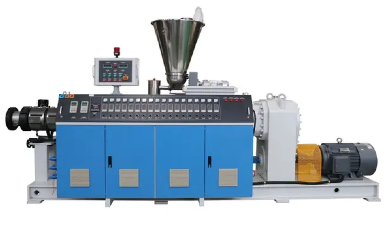
A Plastic Profile Extrusion Line is a highly versatile system used to continuously produce plastic profiles with fixed cross-sections, such as strips, channels, trims, rails, and covers. Unlike injection molding for individual parts, profile extrusion is ideal for long products that can be cut to required lengths.It is widely used because it offers high output, consistent dimensions, and strong customization. A well-configured Plastic Profile Extrusion Line can process different thermoplastics and produce profiles for construction, furniture, electrical systems, appliances, transportation, retail display, and industrial applications.By changing the die, adjusting process settings, and selecting different materials, the same Plastic Profile Extrusion Line can make a wide variety of profile types, making it suitable for multi-industry and OEM/ODM production.
1.Common Materials Used in Plastic Profile Extrusion
Material selection is critical in profile extrusion because it affects product performance, surface quality, processing stability, and end-use suitability. A Plastic Profile Extrusion Line can process many materials, but each resin requires different settings and offers different advantages.
Rigid and Flexible PVC
PVC is one of the most common materials used in a Plastic Profile Extrusion Line, especially for building and decorative profiles.
Rigid PVC is used for trims, cable trunking, and moldings because of its dimensional stability, chemical resistance, and cost efficiency.
Flexible PVC is suitable for sealing strips, soft trims, and protective edge profiles due to its elasticity and impact absorption.
PVC can also be compounded to improve flame retardancy, UV resistance, and color stability for indoor or outdoor use.
PE, PP, and ABS
PE, PP, and ABS are also widely used depending on product needs.
PE offers toughness, flexibility, and chemical resistance, making it suitable for protective and industrial profiles.
PP provides a balance of stiffness, durability, and light weight, often used in technical profiles.
ABS has good rigidity, impact resistance, and surface appearance, making it suitable for appliance trims and decorative parts.
These materials help expand the product range of a Plastic Profile Extrusion Line, especially when PVC is not the best choice.
PC, PMMA, and Other Engineering Plastics
For higher-performance applications, manufacturers may use engineering plastics.
PC is valued for impact resistance and transparency, often used for protective covers and lighting-related profiles.
PMMA offers excellent optical clarity, making it ideal for LED diffuser and display profiles.
Other engineering plastics may be selected for heat resistance, wear resistance, or specialized mechanical performance.
These materials usually require more precise process control, but they can produce higher-value products.
Material Selection Considerations
When choosing materials for a Plastic Profile Extrusion Line, manufacturers should focus on application requirements, including:
Durability
Weather resistance
Flame retardancy
Cost and processability
2.What Products Can Be Made with a Plastic Profile Extrusion Line?
A Plastic Profile Extrusion Line can produce a wide range of simple and complex profiles for functional, decorative, and protective uses across many industries.
Construction and Building Profiles
Construction is a major application area for a Plastic Profile Extrusion Line because many building products require long, continuous profiles. Common products include window and door trims, decorative strips, cable trunking, conduit covers, corner guards, and sealing support profiles. These applications typically require good dimensional stability, UV resistance, and easy installation.
Furniture and Interior Decoration Profiles
A Plastic Profile Extrusion Line is widely used for furniture and interior profiles that need uniform shape and clean surface quality. Typical products include edge bands, cabinet sealing strips, shelf support profiles, decorative moldings, and panel trim strips. In this segment, appearance, color matching, and surface finish are especially important.
Electrical and Cable Management Profiles
Electrical systems use many profiles made by a Plastic Profile Extrusion Line for wire organization and protection. Common products include cable ducts, wire raceways, insulation support channels, and protective wiring covers. These profiles often require flame-retardant materials, stable dimensions, and reliable fitting performance.
Automotive and Transportation Profiles
A Plastic Profile Extrusion Line can produce vehicle-related profiles such as interior trim strips, protective edge trims, sealing carrier profiles, and guide channels. These products are used for decoration, protection, and assembly support, and usually require durable materials and consistent tolerances.
Refrigeration and Appliance Profiles
Appliance and refrigeration equipment also use profiles made by a Plastic Profile Extrusion Line, including gasket support profiles, edge protectors, structural trims, and decorative strips. In these applications, precise fit, stable quality, and resistance to temperature or chemicals are important.
Retail Display and Signage Profiles
Retail display systems commonly use custom profiles produced by a Plastic Profile Extrusion Line. Typical examples include price tag holders, sign frame profiles, shelf edging strips, and LED diffuser profiles. These products often emphasize transparency, printability, and surface appearance.
Industrial and Technical Profiles
Industrial applications include protective guards, equipment edging strips, sliding tracks, partition profiles, and custom machine-use sections. A Plastic Profile Extrusion Line is well suited for these products because it supports custom functional designs based on specific machinery or installation needs.
3.Product Categories and Typical Material Options
The table below shows how a Plastic Profile Extrusion Line can support different product categories with common material choices and application priorities.
Product Category | Typical Products | Common Materials | Key Requirements |
Construction & Building | Trim strips, cable trunking, corner guards, support profiles | Rigid PVC, ABS, PP | Dimensional stability, durability, weather resistance |
Furniture & Interior | Edge bands, cabinet strips, decorative moldings | PVC, ABS, PP | Surface finish, color consistency, easy installation |
Electrical & Cable Management | Cable ducts, raceways, protective covers | PVC, PP, ABS | Flame retardancy, fit accuracy, insulation support |
Automotive & Transportation | Edge trims, guide channels, sealing carriers | PVC, ABS, PC | Tolerance control, impact resistance, durability |
Refrigeration & Appliances | Gasket supports, edge protectors, trims | PVC, ABS, PP | Assembly precision, chemical resistance, appearance |
Retail Display & Signage | Price tag holders, sign frames, LED diffusers | PMMA, PC, PVC | Transparency, optical quality, surface cleanliness |
Industrial & Technical | Guards, sliding tracks, partition profiles | PP, PE, ABS, engineering plastics | Wear resistance, function-specific design, process consistency |
This table highlights that a Plastic Profile Extrusion Line is not limited to one industry. With the right die design and material selection, the same production principle can serve very different markets.
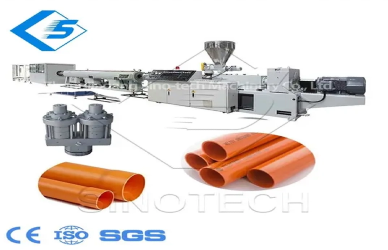
4.Custom Product Possibilities with a Plastic Profile Extrusion Line
A major advantage of a Plastic Profile Extrusion Line is its ability to produce custom profiles for specific installation, performance, and branding needs—not just standard shapes.
Custom Cross-Section Designs
A Plastic Profile Extrusion Line can make many cross-sections, from simple strips to complex hollow or multi-cavity profiles. With the right die design, one profile can combine functions such as support, cable routing, snap-fit assembly, and decorative finishing, helping reduce part count and assembly time.
Co-Extrusion and Multi-Material Profiles
Co-extrusion allows a Plastic Profile Extrusion Line to combine multiple materials in one profile. This helps integrate appearance and function, such as a rigid section for support and a soft section for sealing or anti-slip performance. It can also reduce secondary assembly steps.
Color, Surface, and Finishing Options
A Plastic Profile Extrusion Line supports custom colors and surface finishes, including matte, gloss, and textured effects. Profiles can also be designed for embossing, marking, or printing, which improves product identification, branding, and market differentiation.
5.Factors That Determine What Products Can Be Produced
Although a Plastic Profile Extrusion Line is highly versatile, the products it can make still depend on key technical and process factors. Understanding these factors helps manufacturers choose suitable configurations and maintain stable production quality.
Die Design and Precision
Die design directly determines the profile shape and dimensional accuracy. Poor die design can cause uneven wall thickness, unstable dimensions, and surface defects. For complex profiles, precise tooling is especially important to ensure smooth material flow, stable calibration, and better yield.
Material Compatibility
Different plastics require different processing conditions. The screw design, temperature settings, and downstream configuration of a Plastic Profile Extrusion Line must match the selected material. For example, a line optimized for PVC may need adjustments to process PMMA or PC effectively. Good material compatibility improves melt stability, cooling behavior, and dimensional consistency.
Production Capacity and Line Speed
Output requirements also affect product feasibility. Simple, thin-wall profiles can usually run at higher speeds, while complex or thick-wall profiles need slower and more controlled production. Manufacturers should balance line speed and extruder capacity with product quality needs to avoid sacrificing accuracy or surface finish.
Downstream Equipment Configuration
The downstream system, including cooling, haul-off, cutting, punching, and other online units, strongly affects what products can be produced. A well-matched Plastic Profile Extrusion Line can support more profile types and improve efficiency. Some products need precise cutting, while others require online punching or marking.
Application Standards and Quality Requirements
End-use standards are another key factor. Different industries may require flame retardancy, impact resistance, dimensional consistency, or specific surface quality. A Plastic Profile Extrusion Line must be operated according to these requirements to ensure the profile performs reliably in real applications.
FAQ
Q1: Can a plastic profile extrusion line produce profiles in custom lengths?
Yes. Profiles are produced continuously and then cut to the required lengths using the downstream cutting system.
Q2: Is tooling change necessary when switching to a new profile shape?
Yes. In most cases, a new profile shape requires a different die (and sometimes calibration tooling) to achieve the correct cross-section.
Q3: Can a plastic profile extrusion line produce profiles with special surface textures?
Yes. Depending on tooling and finishing setup, profiles can have matte, glossy, or textured surfaces, and may also support embossing or marking.
Q4: How do manufacturers choose between standard and custom extruded profiles?
They usually consider application fit, performance requirements, tooling cost, production volume, and whether a standard profile can meet installation needs.
Conclusion
A Plastic Profile Extrusion Line can produce a wide variety of products, including building trims, cable management profiles, furniture edging, appliance components, automotive trims, retail display profiles, and custom industrial sections. Its versatility comes from the combination of continuous production, interchangeable die designs, and compatibility with multiple plastic materials.
To fully utilize a Plastic Profile Extrusion Line, manufacturers should focus on three areas: material selection, die precision, and process configuration. These factors determine not only what products can be made, but also how efficiently and consistently they can be produced.
For companies looking to expand product offerings or develop custom profile solutions, a well-planned Plastic Profile Extrusion Line is a strong foundation for scalable and high-value manufacturing.


