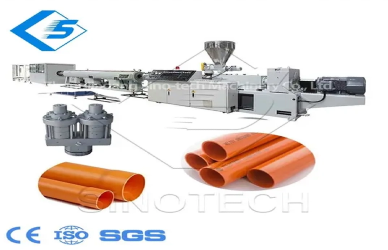
A Plastic Profile Extrusion Line is a continuous system used to produce plastic profiles with fixed cross-sections, such as trims, channels, rails, covers, and decorative strips. It is widely used in building materials, furniture, cable management, appliances, automotive parts, and industrial applications because it provides stable output, consistent dimensions, and flexible customization.
Understanding the main components of a Plastic Profile Extrusion Line is important for equipment buyers and production managers. Each section has a specific role, and final profile quality depends on how well these components work together. Even with a strong extruder, poor calibration, cooling, or haul-off matching can cause deformation, size variation, or surface defects.
In practice, a Plastic Profile Extrusion Line is an integrated system that includes feeding, extrusion, forming, cooling, traction, cutting, collection, and control units. A balanced configuration improves efficiency, reduces waste, and supports stable long-term production.
1.Core Feeding and Extrusion Components in a Plastic Profile Extrusion Line
Raw Material Feeding System
The raw material feeding system is the starting point of a Plastic Profile Extrusion Line. It feeds resin and additives into the extruder in a stable, controlled way, usually through a hopper, loader, and dosing devices for masterbatch, fillers, or stabilizers.
Feeding stability affects extrusion consistency, especially for PVC compounds. For materials like PC or PMMA, drying may be required to prevent moisture-related defects such as bubbles or surface streaks. A stable feeding system helps ensure uniform input and consistent profile quality.
Extruder (Main Machine)
The extruder is the core machine of a Plastic Profile Extrusion Line. It melts, plasticizes, compresses, and conveys material to the die, directly affecting output, melt quality, and process stability.
Manufacturers may use single-screw or twin-screw extruders depending on material and product requirements. Single-screw models are common for many thermoplastics, while twin-screw extruders are often used for PVC or materials that need better mixing. The screw and barrel must work together to deliver a stable melt for forming.
Heating and Temperature Control System
The heating and temperature control system maintains stable melt conditions in the Plastic Profile Extrusion Line. Multiple heating zones along the barrel and die allow precise temperature adjustment during plasticizing and shaping.
Stable temperature control is essential because each material has a specific processing range. Low temperature can cause poor plasticizing and rough surfaces, while high temperature may cause degradation or discoloration. Accurate control improves product consistency, surface finish, and production stability.
2.Forming Components of a Plastic Profile Extrusion Line
Extrusion Die (Mold Head)
The extrusion die (mold head) shapes molten plastic into the required profile cross-section. In a Plastic Profile Extrusion Line, it directly affects profile geometry, wall thickness, and flow balance.
A well-designed die ensures smooth melt flow and helps reduce defects such as warping, uneven thickness, and surface marks. For complex profiles, die precision is especially important. Since different profiles need different flow paths, changing products usually requires changing the die.
Calibration Unit / Vacuum Calibration Table
After leaving the die, the profile is still hot and soft, so it must be shaped and stabilized quickly. This is the role of the calibration unit, often a vacuum calibration table in a Plastic Profile Extrusion Line.
The system uses sizing tools, vacuum force, and cooling support to hold the profile in the correct shape while it solidifies. It is especially important for tight-tolerance, thin-wall, or hollow profiles. Proper calibration improves dimensional consistency and process stability.
3.Cooling and Haul-Off Components
Cooling System
The cooling system helps the profile solidify after calibration. In a Plastic Profile Extrusion Line, cooling may use spray cooling, water tanks, or cooling tables depending on the material and profile type.
Consistent cooling is essential for dimensional stability and surface quality. Uneven cooling can cause bending, twisting, or internal stress. A suitable cooling setup ensures the profile keeps its designed shape before entering the haul-off unit.
Haul-Off (Puller / Traction Unit)
The haul-off unit pulls the profile through the line at a controlled speed. In a Plastic Profile Extrusion Line, the pulling speed must match extrusion output. If too fast, the profile may stretch; if too slow, it may deform.
Haul-off units often use belts or caterpillar traction systems, selected based on profile size and surface sensitivity. Stable pulling force and speed are important for consistent production and accurate dimensions.
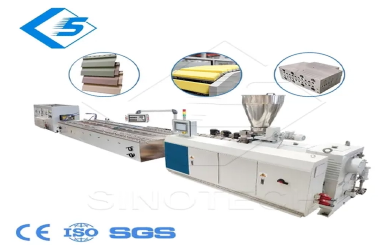
4.Cooling and Haul-Off Components
Cooling System
The cooling system solidifies the profile after calibration. In a Plastic Profile Extrusion Line, cooling may use spray cooling, water tanks, or cooling tables depending on the material and profile type.
Cooling consistency is critical because uneven cooling can cause twisting, bending, or internal stress. Different plastics may also require different cooling methods. A well-designed cooling system helps maintain profile shape, surface quality, and dimensional stability before haul-off.
Haul-Off (Puller / Traction Unit)
The haul-off unit pulls the profile through the line at a controlled speed. In a Plastic Profile Extrusion Line, its speed must match the extrusion output. If it pulls too fast, the profile may stretch; if too slow, the profile may deform.
Haul-off units often use belts or caterpillar traction systems, chosen based on profile size and surface sensitivity. Stable speed and pulling force are essential for line synchronization and consistent product quality.
5.Cutting and Collection Components in a Plastic Profile Extrusion Line
Cutting Unit
The cutting unit divides the continuous profile into required lengths. A Plastic Profile Extrusion Line may use saw cutters, blade cutters, or flying cutters depending on profile material, shape, and speed requirements.
Cutting accuracy affects not only final dimensions but also assembly performance for end users. Poor cutting can cause burrs, uneven edges, or length variation, which may create problems in downstream installation. For high-value products, precise and stable cutting is essential.
Many modern cutting units can be linked to control systems for automatic length setting, improving efficiency and reducing manual error.
Stacker or Collection Table
After cutting, the profile needs to be collected safely to avoid bending, scratching, or deformation. The stacker or collection table is the final handling section of a Plastic Profile Extrusion Line.
For simple production, a manual collection table may be enough. For higher output or longer profiles, automatic stackers help improve labor efficiency and product protection. Proper collection design is especially important for decorative or precision profiles where surface damage can reduce product value.
Although often overlooked, the collection system supports final product quality and smooth packaging operations.
6.Main Components and Their Functions
Component | Main Function | Impact on Product Quality |
Raw Material Feeding System | Feeds resin and additives steadily into extruder | Input consistency, fewer fluctuations |
Extruder | Melts and conveys plastic material | Output stability, melt quality |
Heating & Temperature Control | Maintains correct processing temperature | Surface finish, dimensional consistency |
Extrusion Die | Forms profile cross-section | Shape accuracy, wall thickness balance |
Vacuum Calibration Table | Sizes and stabilizes hot profile | Tolerance control, shape retention |
Cooling System | Solidifies profile uniformly | Dimensional stability, reduced warping |
Haul-Off Unit | Pulls profile at controlled speed | Prevents stretching/compression defects |
Cutting Unit | Cuts profile to required lengths | Length accuracy, edge quality |
Stacker / Collection Table | Receives and arranges finished profiles | Surface protection, handling efficiency |
Control & Auxiliary Systems | Coordinate operation and support utilities | Process stability, productivity |
7.Auxiliary and Optional Components That Improve Performance
Control System (PLC / HMI)
The control system is the coordination center of a Plastic Profile Extrusion Line. It monitors temperatures, speeds, alarms, and synchronization between units. With PLC and HMI interfaces, operators can set parameters more accurately and respond faster to production changes.
A good control system improves repeatability, reduces downtime, and supports safer operation. It is especially useful when producing multiple profile types that require different recipes.
Vacuum and Water Circulation System
Vacuum pumps and water circulation units support the calibration and cooling sections of a Plastic Profile Extrusion Line. Stable vacuum improves shaping performance, while controlled water temperature helps maintain consistent cooling conditions.
If these support systems are unstable, even a good die and extruder may not deliver consistent results. Regular maintenance is important to prevent pressure fluctuation, poor cooling, or contamination.
Optional Units for Special Profiles
Depending on product requirements, a Plastic Profile Extrusion Line may also include co-extrusion units, inline punching devices, printing/marking systems, or inspection tools. These optional units expand product capability and reduce secondary processing.
For example, inline marking improves traceability, while co-extrusion allows multi-material profiles with decorative and functional layers.
FAQ
Q1: Which component most directly determines the profile’s cross-sectional shape?
The extrusion die (mold head) most directly determines the profile’s cross-sectional shape and strongly affects dimensional accuracy.
Q2: Why is a vacuum calibration table necessary in a plastic profile extrusion line?
It helps stabilize the profile shape after extrusion, improves dimensional consistency, and supports cooling during early forming.
Q3: What happens if the haul-off speed does not match the extrusion output?
Speed mismatch can cause stretching, deformation, unstable dimensions, or surface defects in the extruded profile.
Q4: Can a plastic profile extrusion line run without auxiliary systems like vacuum and water circulation?
Basic extrusion may run, but stable production and consistent quality are difficult without proper vacuum and cooling support systems.
Conclusion
The main components of a Plastic Profile Extrusion Line include the feeding system, extruder, heating and temperature control, die, calibration unit, cooling system, haul-off unit, cutting unit, and collection system, supported by control and auxiliary equipment. Each part has a specific function, but the real performance of the line depends on how well all components are matched and synchronized.
For manufacturers, understanding these components is the foundation for selecting equipment, improving profile quality, and increasing production efficiency. A well-balanced Plastic Profile Extrusion Line delivers more than output—it delivers stable, repeatable, and market-ready plastic profiles.


