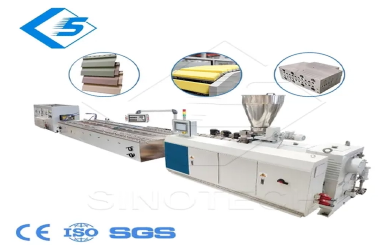
For many manufacturers, the biggest advantage of a Plastic Profile Extrusion Line is flexibility. Customers often request different profile shapes, colors, or materials in small and medium batches, and buying a dedicated line for each product is usually not economical. That is why a common question in production planning is whether one line can run multiple materials or profile types.
The practical answer is yes, in many cases. A properly configured Plastic Profile Extrusion Line can often run different materials and profile shapes. However, success depends on material compatibility, tooling changes, downstream setup, and operator process control. Without proper planning, frequent switching can increase scrap, downtime, and quality issues.
Understanding where flexibility is possible—and where the limits are—helps manufacturers balance customization with production efficiency.
1.Can a Plastic Profile Extrusion Line Run Different Materials?
The Short Answer
A Plastic Profile Extrusion Line can often process different materials, but not all materials are equally suitable on the same setup. Some material changes are relatively easy, while others require major process adjustments, cleaning, or even hardware changes.
For example, switching between similar materials or formulations is usually simpler than switching from a low-temperature material to one that requires tighter temperature control or drying. In all cases, stable restart and contamination prevention are important.
Material Compatibility Factors
Whether one Plastic Profile Extrusion Line can run multiple materials depends on several technical factors. The extruder type (single-screw or twin-screw), screw design, temperature range, and die behavior all affect compatibility. A line optimized for PVC may not perform equally well for PC or PMMA without adjustments.
Moisture-sensitive materials such as PC and PMMA may require pre-drying, while some filled or abrasive materials may increase screw and die wear. In addition, additives, flame retardants, and color systems can affect melt flow and purging difficulty.
In short, material switching is possible, but it must be evaluated based on process requirements, not only machine availability.
Common Material Switching Scenarios
Some material transitions are more practical than others on a Plastic Profile Extrusion Line. Switching between similar PVC formulations is usually manageable with parameter tuning. Switching within the PE/PP family can also be feasible if the line is configured for those materials.
More challenging transitions include moving from ABS to optical-grade PMMA or PC, where temperature control, drying, and surface quality requirements are stricter. These cases may still be possible, but they demand better preparation, cleaning, and process stability.
2.Can a Plastic Profile Extrusion Line Run Different Profile Shapes?
Die and Calibration Change Is the Key
A Plastic Profile Extrusion Line can produce different profile shapes, but in most cases this requires changing the extrusion die and calibration tooling. The die creates the profile cross-section, while the calibration system stabilizes the hot profile dimensions immediately after forming.
If either tool is mismatched, the line may produce unstable dimensions, poor surface finish, or deformation. This is why profile switching is not just a “recipe change”—it is usually a tooling and setup change.
Profile Shape Categories and Line Adaptability
The level of adaptability depends on the shape type. Simple solid profiles are generally easier to switch and stabilize. Hollow or multi-cavity profiles require more precise die flow balance and calibration, which can increase setup difficulty and tuning time.
Decorative profiles may prioritize surface quality and appearance, while functional profiles may require tight tolerances or assembly fit. A Plastic Profile Extrusion Line can often handle both, but the line must be configured to support the required accuracy and downstream handling.
Changeover Time and Production Planning
Even when a Plastic Profile Extrusion Line can run different shapes, changeover time affects efficiency. Die replacement, calibration setup, parameter tuning, and startup stabilization all take time. During this phase, temporary scrap is common.
This makes production planning very important. Grouping similar profiles, materials, or colors can reduce changeover frequency and improve total line utilization. Flexibility is valuable, but it works best with disciplined scheduling.
3.What Must Be Adjusted When Switching Materials or Shapes?
Process Parameter Adjustments
When switching materials or profiles on a Plastic Profile Extrusion Line, operators usually need to adjust barrel and die temperatures, screw speed, haul-off speed, and cooling settings. Different materials have different melt behavior, and different profiles respond differently to cooling and traction.
If parameters are not matched to the new product, defects such as stretching, warping, poor surface finish, or unstable dimensions may occur. Standard parameter records for each product help reduce trial-and-error time.
Tooling and Downstream Adjustments
Material or shape switching often requires more than parameter changes. Operators may need to change the die, calibration tooling, cutter settings, and haul-off pressure. Some profiles also need different cutting methods or length control settings.
A flexible Plastic Profile Extrusion Line usually performs better when tooling interfaces are standardized and downstream equipment is easy to adjust.
Cleaning and Purging Requirements
Cleaning and purging are essential when changing materials, especially for different colors or materials with different thermal behavior. Without proper purging, contamination can cause black specks, color streaks, gel marks, or unstable melt flow.
Good purging practice improves restart quality and reduces scrap. This is especially important for decorative profiles or transparent products where surface defects are more visible.
4.Main Limitations of Running Multiple Materials or Shapes on One Line
Technical and Quality Limitations
A Plastic Profile Extrusion Line has practical limits based on extruder size, torque, screw design, and temperature capability. Some materials simply do not process well on a line designed for another resin family. Likewise, very tight-tolerance or high-cosmetic products may need dedicated tooling or a more stable, specialized setup.
Economic Limitations
Even if switching is technically possible, frequent changeovers can reduce productivity. Tooling costs, cleaning time, startup scrap, and operator labor all add cost. In some cases, a dedicated line is more economical for high-volume products, while a flexible line is better for custom or mixed production.
5.How to Improve Flexibility on a Plastic Profile Extrusion Line
Flexible Configuration, Modular Tooling, and Operator Control
To improve flexibility, manufacturers should select a Plastic Profile Extrusion Line with a suitable extruder range, stable control system, and adjustable downstream units. Modular tooling, quick-change procedures, and stored parameter recipes can greatly reduce setup time.
Operator training is equally important. Experienced operators can identify process changes faster, stabilize production sooner, and reduce scrap during material or profile switching. Flexibility is not only a machine feature—it is also a process management capability.
6.Switching Different Materials or Shapes on One Line
Switching Item | Usually Possible on One Line? | Main Requirements | Main Risks |
PVC to PVC (different formulations) | Yes | Parameter tuning, purging | Color residue, melt instability |
PE to PP (similar line capability) | Often | Temperature and speed adjustment | Dimension variation |
ABS to PC/PMMA | Sometimes | Better control, drying, cleaning | Surface defects, instability |
Shape change (simple to simple) | Yes | Die + calibration change | Setup scrap |
Shape change (simple to hollow/multi-cavity) | Yes, but harder | Precision tooling, longer tuning | Deformation, tolerance issues |
Color change (dark to light) | Yes | Thorough purging and cleaning | Streaks, contamination |
FAQ
Q1: Can one extrusion line switch between rigid and flexible PVC?
Yes, in many cases it can, but process settings, tooling behavior, and cooling conditions may need adjustment because the melt flow and solidification behavior are different. In some cases, operators may also need to fine-tune haul-off speed and temperature zones to maintain stable dimensions and surface quality.
Q2: Does changing profile shape always require a new calibration setup?
In most cases, yes. Even if the line remains the same, different profile geometries usually need matching calibration tooling to ensure shape stability and dimensional accuracy. This is especially important for hollow, thin-wall, or tight-tolerance profiles where improper calibration can quickly cause deformation.
Q3: Can frequent changeovers damage production efficiency?
Yes. Frequent switching can increase downtime, startup scrap, and labor cost if changeover procedures are not standardized. It may also reduce equipment utilization and create planning pressure, especially when small orders require repeated material, color, and tooling changes in a short time.
Q4: What is the best way to reduce defects after a material switch?
Use proper purging, clean key flow paths, apply the correct parameter recipe, and allow enough time for process stabilization before full production. It is also helpful to keep standardized changeover checklists and past process records so operators can restart faster and reduce trial-and-error adjustments.
Conclusion
One Plastic Profile Extrusion Line can often run different materials and profile shapes, but it still has practical and process-related limits. The success of multi-product production depends on factors such as material compatibility, die and calibration changes, process parameter control, and disciplined changeover planning. If these factors are not managed properly, switching can result in more scrap, longer downtime, unstable dimensions, and inconsistent surface quality.
For manufacturers, the goal is not only to make switching possible, but to make it efficient, repeatable, and cost-effective in daily production. With the right line configuration, modular tooling, standardized setup procedures, reliable parameter records, and trained operators, a Plastic Profile Extrusion Line can deliver both flexibility and stable product quality, helping companies respond faster to diverse customer demands while maintaining production efficiency.


