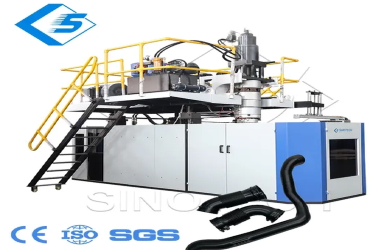
Blow molding is a widely used manufacturing process in the plastic industry, designed to produce hollow plastic products such as bottles, containers, and automotive parts. The process involves melting plastic material and inflating it inside a mold using air pressure, allowing manufacturers to create products with complex shapes and consistent wall thicknesses. Blow molding plays a crucial role in high-volume production, offering cost-effective and efficient solutions for industries like packaging, automotive, and consumer goods. Understanding the key components of a blow molding machine is essential for ensuring its efficient operation. Each part, from the extruder to the cooling system, plays a critical role in shaping the plastic and ensuring the production of high-quality, consistent products. Proper knowledge of these components helps manufacturers optimize their machines for better performance, reduced downtime, and increased production efficiency.
Main Components of a Blow Molding Machine
Blow molding machines are complex systems consisting of several key components, each playing a critical role in shaping and producing high-quality plastic products. Below is an overview of the main components and their functions in the blow molding process:
1. Extruder (for Extrusion Blow Molding)
Function: The extruder is responsible for melting and feeding plastic material into the machine. It forms the parison, a hollow tube of molten plastic, which will later be inflated into the final shape.
Components:
Barrel: Holds the plastic pellets and provides heat to melt them.
Screw: Rotates to push the melted plastic through the barrel.
Die: Shapes the molten plastic into a uniform parison, which will later be inflated.
2. Injection Unit (for Injection Blow Molding)
Function: In injection blow molding, the injection unit is responsible for forming a preform (a small solid plastic part) using injection molding techniques. This preform is then inflated inside the mold.
Components:
Hopper: Holds and feeds the raw plastic pellets into the injection unit.
Screw: Melts and injects the plastic into the mold to form the preform.
Injection Nozzle: Delivers the molten plastic into the mold cavity.
3. Mold
Function: The mold is the part that shapes the product by enclosing the plastic parison. The mold defines the final shape of the product during the blow molding process.
Components:
Mold Halves: The two parts of the mold that come together to form the cavity for the product.
Core: The inner part of the mold that creates the hollow cavity of the product.
Cooling Channels: Channels within the mold that help cool and solidify the molded plastic.
4. Blow Pin
Function: The blow pin injects air into the molten parison, inflating it to conform to the shape of the mold, forming the final product.
Components:
Air Compressor: Provides the air pressure required to inflate the parison.
Nozzle: Directs the airflow into the parison to expand it to the desired shape.
5. Clamping Unit
Function: The clamping unit holds the mold halves together during the molding process, ensuring that the mold remains securely closed while the plastic is inflated and cooled.
Components:
Hydraulic or Mechanical Clamps: These clamps apply the necessary force to keep the mold halves tightly closed during the blow molding process.
6. Cooling System
Function: The cooling system cools the molded plastic, allowing it to solidify and retain its shape once it has been inflated in the mold.
Components:
Cooling Channels: Tubes or passages that circulate water or air to remove heat from the molded plastic.
Water or Air Cooling Systems: These systems circulate cool water or air through the mold to help cool and solidify the plastic quickly.
7. Ejection System
Function: After the plastic has cooled and solidified, the ejection system ejects the molded product from the mold, allowing for the next cycle to begin.
Components:
Ejector Pins: Mechanisms that push the molded product out of the mold cavity.
Pneumatic Systems: Use air pressure to assist in ejecting the finished product from the mold.
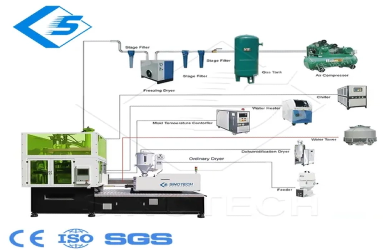
How Each Component Works Together in a Blow Molding Machine
In a blow molding machine, each component plays a critical role in ensuring the efficient production of high-quality plastic products. The process involves the coordination of several key parts, working in tandem to create the final product. Here's how these components interact to complete the blow molding process:
1. Extruder and Injection Unit (for Extrusion and Injection Blow Molding)
The extruder (in extrusion blow molding) or injection unit (in injection blow molding) is where the process begins. The extruder melts plastic pellets and forms a parison, a hollow tube of molten plastic, which will be inflated into the product's shape. In injection blow molding, the plastic is injected into a mold to create a preform, a small solid plastic piece, which is then blown into the final shape.
Coordination: The extruder feeds the molten plastic into the system, where it either forms a parison (extrusion) or a preform (injection). The precise control over the material temperature and pressure ensures that the plastic flows smoothly and evenly.
2. Mold
Once the parison or preform is ready, it is transferred into the mold, where it takes its final shape. The mold consists of two halves that are tightly clamped together to form the cavity, and the core inside the mold creates the hollow space. The mold also contains cooling channels to regulate the temperature of the plastic, solidifying it as it forms.
Coordination: The mold closes around the parison or preform, shaping the product. At this point, the material’s temperature and pressure are critical, as it needs to be soft enough to inflate but not so hot that it can't retain its shape once formed.
3. Blow Pin and Clamping Unit
The blow pin injects air into the parison (or preform), expanding it to fill the mold’s cavity. The clamping unit holds the mold halves together, ensuring that no plastic leaks out during the inflation process and that the mold remains closed during the molding cycle.
Coordination: The blow pin injects air at the right moment, inflating the parison so it conforms to the mold. Simultaneously, the clamping unit ensures that the mold halves remain tightly secured, allowing for proper inflation without any material loss.
4. Cooling System
Once the parison has expanded to fill the mold, it must cool and solidify to retain its shape. The cooling system circulates water or air through the mold’s cooling channels to lower the temperature of the plastic quickly, solidifying the product.
Coordination: The cooling system is synchronized with the molding process, as it needs to kick in immediately after the blowing phase. This helps the molded product solidify before being ejected, ensuring that it retains its final form without warping or deforming.
5. Ejection System
Once the plastic has cooled and solidified, the ejection system comes into play. It uses ejector pins or pneumatic systems to push the finished product out of the mold, making space for the next cycle to begin.
Coordination: The ejection system activates only once the molded product has reached a sufficient level of cooling to prevent distortion. It ensures that the product is removed from the mold without damage, allowing the mold to open for the next cycle.
Maintenance and Optimization of Components in Blow Molding Machines
Regular maintenance is crucial to ensure blow molding machines operate at maximum efficiency, reduce downtime, and maintain high product quality. Here’s how to maintain and optimize each key component:
1. Extruder and Injection Unit
Maintenance: Prevent clogs and overheating by regularly cleaning the extruder and inspecting the screw and barrel for wear.
Optimization: Ensure proper alignment and lubrication of the injection unit and check heating elements for efficiency.
2. Mold
Maintenance: Clean the mold to remove plastic residues, and inspect cooling channels for blockages.
Optimization: Check for mold wear, cracks, and ensure proper alignment to avoid product defects.
3. Blow Pin
Maintenance: Keep the blow pin nozzle clean to prevent obstructions and check for air leaks.
Optimization: Lubricate moving parts and ensure smooth operation to maintain consistent inflation.
4. Clamping Unit
Maintenance: Inspect clamps and hydraulic systems for leaks or misalignment.
Optimization: Lubricate and check for proper function to ensure the mold stays securely closed during production.
5. Cooling System
Maintenance: Clean cooling channels regularly and check for blockages.
Optimization: Ensure the system operates at the correct pressure and temperature to prevent warping.
6. Ejection System
Maintenance: Inspect ejector pins and pneumatic systems for smooth operation.
Optimization: Lubricate and check for wear to prevent jams and ensure the molded product is ejected properly.
Frequently Asked Questions (FAQ):
1.What is the function of the extruder in a blow molding machine?
The extruder melts and feeds plastic material into the machine, forming a parison for molding.
2.What is the purpose of the mold in blow molding?
The mold shapes the plastic parison into the desired final product by enclosing it during the blow molding process.
3.How does the blow pin work in the blow molding process?
The blow pin injects air into the parison, expanding it to fill the mold and take its shape.
4.What role does the cooling system play in blow molding?
The cooling system helps solidify the molded plastic, ensuring that the product retains its shape after molding.
Conclusion
In conclusion, the main components of a blow molding machine, including the extruder, mold, blow pin, clamping unit, cooling system, and ejection system, all play essential roles in ensuring successful blow molding operations. The extruder or injection unit is responsible for melting and shaping the plastic, while the mold defines the final product's shape. The blow pin inflates the plastic to fill the mold, and the clamping unit securely holds the mold during the process. The cooling system quickly solidifies the plastic to retain its shape, and the ejection system removes the finished product once it has cooled. Proper maintenance and coordination of these components are crucial to achieving efficient, high-quality production and minimizing downtime in the blow molding process.


