
Views: 0 Author: Site Editor Publish Time: 2026-06-09 Origin: Site
A 5L jerry can and a 30L jerry can may look like the same product in different sizes, but they place very different demands on the production line. Wall thickness, handle strength, cooling time, leak resistance, and stacking performance all become harder to control as the container gets larger. For manufacturers using Blow Molding Machines, the real challenge is not just forming the shape, but producing stable containers that can survive filling, transport, storage, and daily handling. This article explains the production logic, machine setup, material choices, and quality checks behind reliable HDPE jerry can manufacturing.
Most 5L, 10L, 20L and 30L HDPE jerry cans are produced by extrusion blow molding because the process is well suited to hollow containers with integrated handles, thick walls and strong base seams. HDPE pellets are melted inside the heated extruder barrel, pushed forward by a rotating screw, and shaped through a die head into a hollow parison.
The basic production flow usually includes:
● Melting HDPE resin and forming a stable parison
● Closing the mold around the parison and sealing the base
● Blowing compressed air through the blow pin
● Cooling the container inside the mold cavity
● Ejecting the jerry can and trimming excess flash
Blow Molding Machines used for jerry cans must control extrusion output, parison length, clamping movement, blowing pressure, mold cooling and ejection in one stable cycle. A small change in any area can affect wall thickness, container weight or leakage risk, especially on the handle, corners and pinch-off seam.
Injection blow molding and stretch blow molding can produce other types of plastic bottles, but they are usually not the main choice for large HDPE jerry cans. Injection blow molding is better for small bottles with precise neck finishes, while stretch blow molding is mainly used for PET bottles made from preforms. For 5L–30L HDPE jerry cans, extrusion blow molding remains the more practical route.
HDPE is the standard material for most plastic jerry cans because it offers a strong balance of chemical resistance, impact strength, stiffness and processability. A container used for detergent does not face the same risks as one used for fuel, agricultural chemicals or edible oil, so the resin grade should match the final application. Density, tensile behavior, environmental stress crack resistance and cap compatibility all affect whether the finished can performs reliably.
Food-grade containers require approved resin and compatible additives. Outdoor containers may need UV stabilizers to reduce degradation during sunlight exposure. Color masterbatch can support branding or liquid identification, but the pigment must not weaken the material or interfere with compliance. For industrial jerry cans, resin selection should also consider stacking strength, drop performance and long-term contact with the filled product.
Material consistency has a direct effect on how Blow Molding Machines perform during production. Melt Flow Index influences how the resin flows, how the parison hangs and how easily the material distributes around handles, corners and ribs. A resin that flows too easily may increase parison sag, while a resin with poor melt strength can create uneven wall thickness.
Regrind can reduce material cost, especially because flash is created during jerry can production. However, too much regrind may reduce impact strength, affect color consistency and increase process variation. Manufacturers should define a controlled regrind ratio instead of feeding recycled flash back into the system without limits.
Larger jerry cans are not only bigger versions of 5L containers. As volume increases, the parison becomes heavier, the mold becomes larger, cooling time becomes longer and the container becomes more sensitive to uneven wall distribution. A machine that can produce a 5L can smoothly may not have enough extrusion output, shot capacity or clamping stability for a 20L or 30L design.
For 5L jerry cans, smaller extrusion blow molding equipment may be enough if the mold, handle shape and production speed are not demanding. A 10L container requires stronger clamping and better cooling control because the handle and base carry more stress. For 20L and 30L jerry cans, an accumulator head is often preferred because it can deliver a larger amount of molten plastic more consistently. This helps reduce parison sag and improves material distribution before the mold closes.
Jerry Can Size |
Machine Requirement |
Main Process Risk |
Quality Priority |
5L |
Smaller EBM machine |
Thin handle or corner areas |
Leak resistance |
10L |
Stronger clamp and stable cooling |
Uneven wall thickness |
Handle and base strength |
20L |
Accumulator head recommended |
Parison sag and longer cooling |
Stacking strength |
30L |
High clamping force and stable shot control |
Deformation and weak pinch-off |
Drop and leak performance |
The accumulator head stores molten HDPE and releases it as a controlled shot, essential for larger jerry cans. Without stable shot control, the parison can sag, leaving uneven wall thickness and weak spots.
Parison programming adjusts the die gap so handles, corners, ribs, and base areas receive more material where stress is highest. Proper programming reduces scrap, improves safety, and ensures consistent wall thickness across repeated cycles.
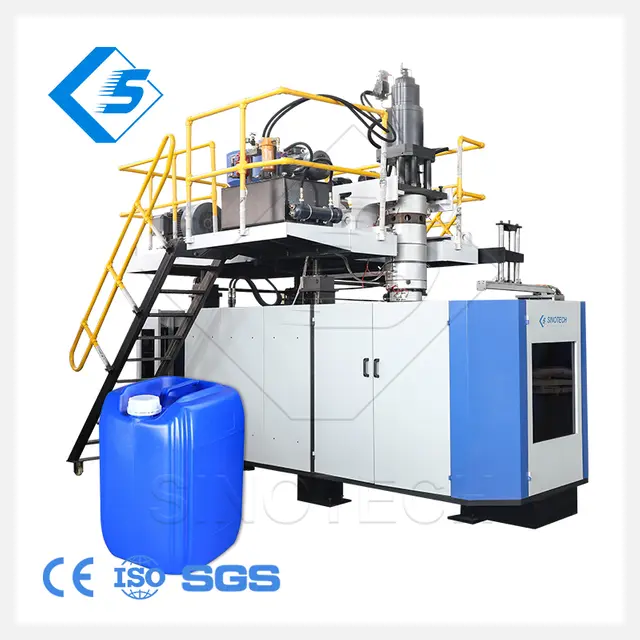
Drive type affects energy use, noise, maintenance, and control precision. Hydraulic machines have strong clamping and lower upfront cost but require more maintenance. Servo-hydraulic systems offer better energy efficiency, while fully electric machines provide precise motion control and quieter operation, usually at higher initial investment. Total production cost, not purchase price alone, should guide the choice of Blow Molding Machines.
The mold determines far more than the outside shape of the jerry can. Handle geometry, stacking ribs, corner radius, neck finish, surface texture and pinch-off design all influence how the container performs after filling. A strong machine cannot compensate for a poorly designed mold that creates thin corners, weak seams or uneven cooling.
Pinch-off design is especially important for liquid containers. If the base seam is weak, the can may pass visual inspection but fail during filling, dropping or long-term storage. Neck finish accuracy also matters because the cap system must seal consistently without excessive torque. Cooling channel layout affects cycle time and dimensional stability, so mold cooling should be considered during the design stage rather than after defects appear.
Cycle time is a major productivity factor, but faster cycles are useful only when the product remains stable. A 5L jerry can normally cools faster than a 20L or 30L container because less plastic must solidify. Larger jerry cans need longer cooling to prevent warpage, base deformation or weak handle areas.
Poor cooling balance can cause one side of the container to shrink differently from the other. Short cooling time may also make the container look acceptable at ejection but deform later on the conveyor or during stacking. Stable output matters more than maximum speed, especially when the product is used for chemicals or heavy liquids.
Quality inspection should begin with measurable product features, not only visual appearance. Wall thickness mapping shows whether the parison program is distributing material correctly across the handle, corners, body and base. Container weight consistency also matters because unstable weight often signals extrusion variation, material inconsistency or poor shot control.
Neck finish measurement is necessary because the cap must seal without damaging the thread or causing leakage. Capacity checks confirm that the molded volume matches the required fill level. Handle strength, base flatness and stacking behavior should also be checked before approving mass production. These inspections help manufacturers detect problems before they become customer complaints.
Jerry cans are handled, filled, stacked, transported and sometimes stored outdoors. Leak testing checks whether the neck, seam and base can hold pressure or liquid without failure. Drop testing simulates the impact that containers may face during loading or transport. Stacking tests help confirm whether the can can support warehouse loads without collapsing or distorting.
Top load testing is useful when containers will be palletized or stacked for long periods. Environmental Stress Crack Resistance, or ESCR, is especially relevant for chemicals because some liquids can accelerate cracking under stress. A container may look strong when new, but poor resin selection or weak wall distribution can cause long-term failure.
Test |
What It Checks |
Why It Matters |
Leak test |
Neck, seam and base sealing |
Prevents liquid loss |
Drop test |
Impact resistance |
Simulates transport damage |
Stacking test |
Load-bearing strength |
Supports warehouse storage |
Wall thickness test |
Material distribution |
Finds weak areas |
ESCR test |
Stress cracking resistance |
Important for chemicals |
Uneven wall thickness is usually linked to parison programming, die gap control, unstable extrusion or cooling imbalance. Leaks often start at the pinch-off seam, neck finish or areas damaged by excessive trimming. Excessive flash may come from an oversized parison, poor mold alignment, incorrect clamp pressure or worn trimming blades.
Warpage is commonly related to uneven cooling or insufficient cooling time. Surface roughness, black spots or weak seams may point to contaminated resin, unstable barrel temperature or excessive regrind. Weak handle areas often appear when the material distribution does not match the stress points of the jerry can. Experienced operators use these defects as process signals rather than treating them as random failures.
Flash can be recycled, but it is not free material. More flash means more trimming labor, more granulation, more regrind management and a higher chance of inconsistent resin quality. Reducing flash through better parison control and mold alignment can improve both product quality and production cost.
Buyers should not evaluate Blow Molding Machines only by brochure capacity. The real test is whether the equipment can run the actual jerry can design, resin grade, mold size, neck finish and production target. A machine listed for a certain volume may still struggle if the product has a heavy handle, thick walls, deep ribs or strict stacking requirements.
Before purchase, verify maximum mold size, shot capacity, clamping force, extrusion output, mold changeover method and required auxiliary equipment. Energy consumption, spare parts availability, installation support and operator training should also be checked. A low machine price can become expensive if it causes slow cycles, frequent downtime or high scrap.
Trial samples should be tested under real production conditions, not only inspected as display products. Record actual container weight, wall thickness distribution, handle strength, bottom pinch-off strength, neck fit and cap sealing performance. Leak test, drop test and flash level should be checked before the machine is approved for mass production.
A useful trial run should also measure scrap rate, cooling stability and operator adjustment difficulty. If only an expert technician can keep the machine stable, daily production may become difficult after installation. The safest buying decision comes from samples, data and process repeatability, not from catalog claims.
Making 5L, 10L, 20L and 30L plastic jerry cans requires a balanced production system, not just a machine with enough capacity. HDPE grade, parison control, mold cooling, clamping force, trimming, and leak testing all affect whether the final container can handle filling, storage, transport, and repeated use.
For manufacturers planning or upgrading jerry can production, SINOTECH Machinery Co., Ltd. provides Blow Molding Machines and supporting equipment designed around real container requirements. The right setup can help improve wall thickness consistency, reduce scrap, stabilize output, and produce stronger HDPE jerry cans with fewer production risks.
A: HDPE jerry cans are usually made with extrusion blow molding machines because they can form hollow containers with handles, thick walls, and strong pinch-off seams.
A: HDPE offers good impact strength, chemical resistance, stiffness, and process stability, making it suitable for liquids such as detergents, lubricants, fuels, and food-grade products.
A: Yes. Larger jerry cans need stronger clamping, better cooling, stable parison control, and often an accumulator head to reduce sagging and uneven wall thickness.
A: Leaks usually come from weak pinch-off seams, poor neck finish, thin handle areas, excessive trimming, or unstable parison thickness during the molding process.
A: Manufacturers should check wall thickness, container weight, neck fit, leak resistance, drop strength, stacking performance, flash level, and cap sealing before approving production.
A: Regrind can be used in controlled amounts, but excessive recycled material may reduce impact strength, affect color consistency, and increase the risk of process variation.
